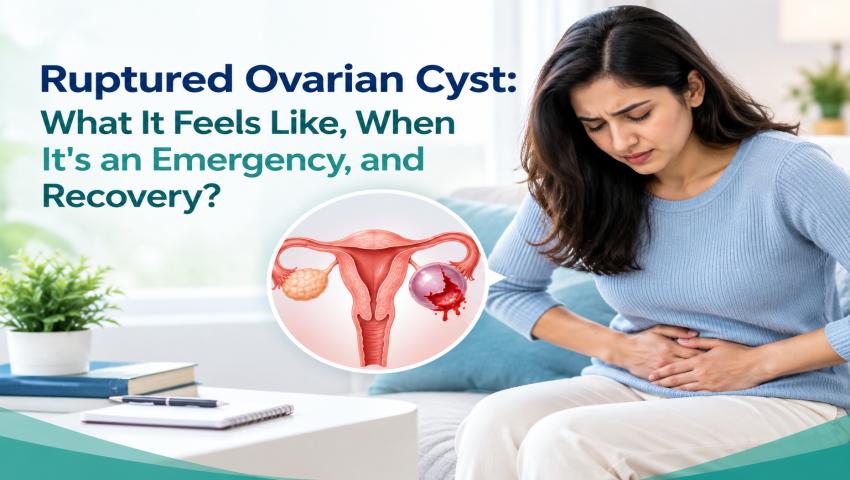
Ruptured Ovarian Cyst: What It Feels Like, When It’s an Emergency, and Recovery?
It usually arrives without warning. One moment you are fine, and the next there is a sharp pain low on one side — during exercise, during sex, or while doing nothing at all.
A ruptured ovarian cyst is common, and most of the time the body handles it on its own within a few days. But a small number of ruptures cause significant internal bleeding or twist the ovary, and those need attention within hours rather than days.
Here is how to tell the difference.
Go to a hospital now if you have any of these: Severe pain that is getting worse · Dizziness, fainting or feeling cold and clammy · Rapid heartbeat or breathlessness · Vomiting with severe pelvic pain · Fever with pain · Pain with a positive pregnancy test
Do not drive yourself. Do not wait until morning.
What a Ruptured Ovarian Cyst Feels Like?
1. The Moment of Rupture:
Most women describe it the same way: sudden, sharp, and clearly on one side. Not a build-up — a moment. It often happens mid-cycle, around ovulation, or after physical activity, intercourse or a sudden movement. Some women feel a brief “pop” before the pain arrives.
2. The Hours Afterwards:
The sharp pain typically softens into a dull, persistent ache across the lower abdomen as fluid from the cyst spreads and irritates the lining. You may also notice light spotting, bloating, nausea, or discomfort when passing urine. Most of these ovarian cyst rupture symptoms settle over one to three days.
3. How It Differs from Period Pain?
Period cramps are central, rhythmic, and familiar. They come and go in waves and respond to a painkiller and a hot water bag. A rupture is sudden pelvic pain on one side, unfamiliar, and usually unrelated to the day of your cycle. That combination — one-sided, sudden, and not like anything you normally get — is what should send you for a scan.
When a Ruptured Ovarian Cyst Is an Emergency?
1. Signs of Internal Bleeding:
Every cyst bleeds a little when it bursts. Occasionally a blood vessel is involved and the bleeding does not stop. Warning signs are dizziness when standing, a racing pulse, pale or clammy skin, breathlessness, shoulder-tip pain, and pain that worsens hour by hour instead of easing. Significant internal bleeding is uncommon, but it is the reason severe rupture is treated as a surgical emergency.
2. Signs of Ovarian Torsion:
A cyst can make the ovary heavy enough to twist on its own blood supply. Ovarian torsion causes intense, often colicky one-sided pain with vomiting, and the pain does not settle at all.
3. Why Timing Matters for the Ovary?
A twisted ovary loses its blood supply. Untwisted early, it usually recovers completely. Left for too long, the tissue can be lost permanently. That is the whole argument against waiting it out: ovarian torsion is the one situation where hours genuinely decide whether an ovary is saved.
Recovery After a Ruptured Ovarian Cyst:
1. If No Surgery Was Needed:
Most ruptures need nothing more than rest, pain relief and observation. Expect soreness for three to seven days and full recovery within one to two weeks. A follow-up scan is usually arranged to confirm the fluid has absorbed and the ovary looks normal.
2. After Laparoscopic Surgery:
Where bleeding or torsion requires surgery, it is almost always done by keyhole — two or three small incisions, a camera, and a same-day or next-day discharge. Most women return to desk work within one to two weeks after laparoscopic surgery for an ovarian cyst, and to full activity in three to four.
3. What to Avoid While Healing?
Heavy lifting and strenuous exercise for two weeks
Intercourse until your doctor confirms it is safe
Driving while still on strong pain medication
Ignoring pain that returns or worsens after initially improving
Swimming or tub baths until any incisions have fully healed
How Doctors Confirm a Rupture?
Diagnosis starts with an examination and a pelvic ultrasound, which shows free fluid around the ovary and whether the cyst has collapsed.
A pregnancy test is done in every case — not because a rupture affects pregnancy, but because an ectopic pregnancy can look almost identical and is far more dangerous. Blood tests check haemoglobin to gauge how much bleeding has occurred.
Reducing the Chance of It Happening Again:
Have known cysts monitored with scans at the interval your gynaecologist advises
Discuss hormonal contraception, which can prevent new functional cysts forming
Report recurring one-sided pain instead of treating it as period pain
Get large or persistent cysts assessed before they grow
Dr. Asmita Dongare is an MRCOG-trained gynaecologist with over 18 years of experience in Obstetrics and Gynaecology, practising at Cloverleaf Speciality Clinic in Wakad and Jupiter Hospital in Baner. She manages ovarian cysts medically and surgically, with a preference for minimally invasive techniques that preserve ovarian tissue and future fertility wherever possible. Book an appointment
Sharp pain usually settles within a few hours and the dull ache within one to three days. Pain that worsens after a day, or comes with dizziness, needs urgent assessment.
Usually not. A single rupture rarely damages the ovary. Untreated torsion, however, can, which is why sudden severe one-sided pain should never be left overnight.
It can, particularly with functional cysts that form each cycle. Dr. Asmita Dongare can discuss preventive options if you have had more than one episode.